Anúncios
AI-powered inventory management is poised to significantly reduce stockouts for US retailers by 15% in 2025 by optimizing forecasting, demand sensing, and operational efficiency through practical, data-driven solutions.
Anúncios
In the dynamic landscape of modern retail, staying ahead means embracing innovation. For US retailers, the challenge of managing inventory efficiently and avoiding costly stockouts is paramount. This article explores how AI-powered inventory management is set to revolutionize the sector, projecting a significant 15% reduction in stockouts by 2025, and offering practical, actionable solutions for businesses looking to thrive.
Anúncios
The Stockout Scourge: Why Traditional Methods Fall Short
Stockouts, those frustrating moments when a customer can’t find the product they want, represent more than just a lost sale; they erode customer loyalty and damage brand reputation. Traditional inventory management, often reliant on historical data and manual adjustments, struggles to keep pace with today’s volatile market demands. Factors like unforeseen supply chain disruptions, sudden shifts in consumer trends, and localized events can quickly render static forecasts obsolete.
The limitations of conventional approaches stem from their inability to process vast, disparate datasets in real-time. Human planners, no matter how experienced, simply cannot synthesize the sheer volume of information needed to make truly optimized decisions across thousands of SKUs and multiple locations. This often leads to either overstocking, tying up capital, or understocking, resulting in missed opportunities and dissatisfied customers. The retail environment of 2025 demands a more agile, predictive solution.
Moreover, the hidden costs of stockouts extend beyond immediate revenue loss. They include the expense of expedited shipping to replenish items, the diversion of staff time to handle complaints, and the long-term impact on customer lifetime value. Understanding these multifaceted repercussions underscores the urgent need for a transformative approach to inventory control.
The Inefficiency of Static Forecasting
Many retailers still rely on annual or quarterly forecasts derived from past sales figures. While historical data provides a baseline, it rarely accounts for the nuances of current market conditions or emerging patterns. This static view creates vulnerabilities.
- Lagging indicators: Traditional models react to past events, not predict future ones.
- Limited data sources: They often ignore external factors like weather, social media trends, or local events.
- Manual intensive: Requires significant human effort for adjustments, prone to error.
- Scalability issues: Becomes unmanageable with a large product assortment or store network.
These shortcomings highlight why a paradigm shift is necessary, moving from reactive management to proactive prediction, which is precisely where AI excels.
In conclusion, the inherent weaknesses of traditional inventory methods are no longer sustainable for competitive US retailers. The complex interplay of consumer behavior, global supply chains, and economic fluctuations demands a more intelligent, adaptive system capable of minimizing stockouts and maximizing profitability.
AI’s Predictive Power: Beyond Basic Forecasting
Artificial Intelligence elevates inventory management from reactive guesswork to proactive precision. Unlike traditional statistical models, AI algorithms can learn from vast datasets, identify complex patterns, and make highly accurate predictions about future demand. This capability is not just about crunching numbers; it’s about understanding the subtle forces that drive consumer behavior and supply chain dynamics.
AI’s predictive power extends far beyond simple sales history. It ingests and analyzes a multitude of variables, providing a holistic view that human analysts simply cannot achieve. This comprehensive data integration allows for a level of accuracy that was previously unimaginable, making it a game-changer for retailers aiming for optimal stock levels.
Leveraging Machine Learning for Demand Sensing
Machine learning, a subset of AI, is at the core of advanced demand sensing. These algorithms continuously learn and adapt, improving their accuracy over time. They don’t just look at what happened; they try to understand why it happened and what might happen next.
- Granular analysis: Predicts demand at SKU, store, and even individual customer level.
- External data integration: Incorporates weather, local events, social media sentiment, competitor activities, and economic indicators.
- Pattern recognition: Identifies subtle trends, seasonality, and promotional impacts that are invisible to human eyes.
- Self-correction: Continuously refines predictions based on actual sales data and unforeseen events.
This continuous learning process means that as market conditions evolve, the AI system adapts, providing increasingly accurate forecasts. The result is a significant reduction in both overstocking and stockouts, leading to healthier margins and happier customers.
The true power of AI in this context lies in its ability to transform raw data into actionable insights, enabling retailers to anticipate rather than simply respond. This foresight is critical for maintaining competitive advantage in a fast-paced market.
Practical AI Solutions for Stockout Reduction in 2025
Implementing AI for inventory management isn’t a futuristic dream; it’s a present-day reality with tangible benefits. US retailers in 2025 are already leveraging several practical AI solutions to directly combat stockouts and optimize their supply chains. These solutions range from sophisticated forecasting engines to automated reordering systems, all designed to create a more resilient and responsive inventory ecosystem.
The key to success lies in integrating these AI tools seamlessly into existing operational workflows, ensuring that data flows freely between systems and that insights are immediately actionable. This integration minimizes disruption while maximizing the positive impact on inventory efficiency and customer satisfaction.
Implementing Predictive Analytics Platforms
Predictive analytics platforms utilize AI and machine learning to forecast demand with unprecedented accuracy. These systems go beyond simple trend analysis, incorporating a multitude of factors to provide a clear picture of future needs.
- Dynamic forecasting: Adjusts predictions daily or even hourly based on new data.
- Anomaly detection: Flags unusual demand spikes or drops for immediate investigation.
- Promotion optimization: Forecasts the impact of marketing campaigns on specific product demand.
- Supplier lead time prediction: Accounts for potential delays in the supply chain to prevent shortages.
By providing such precise and timely forecasts, retailers can significantly reduce the risk of stockouts, ensuring that popular items are always available when customers want them.
Automated Reordering and Allocation Systems
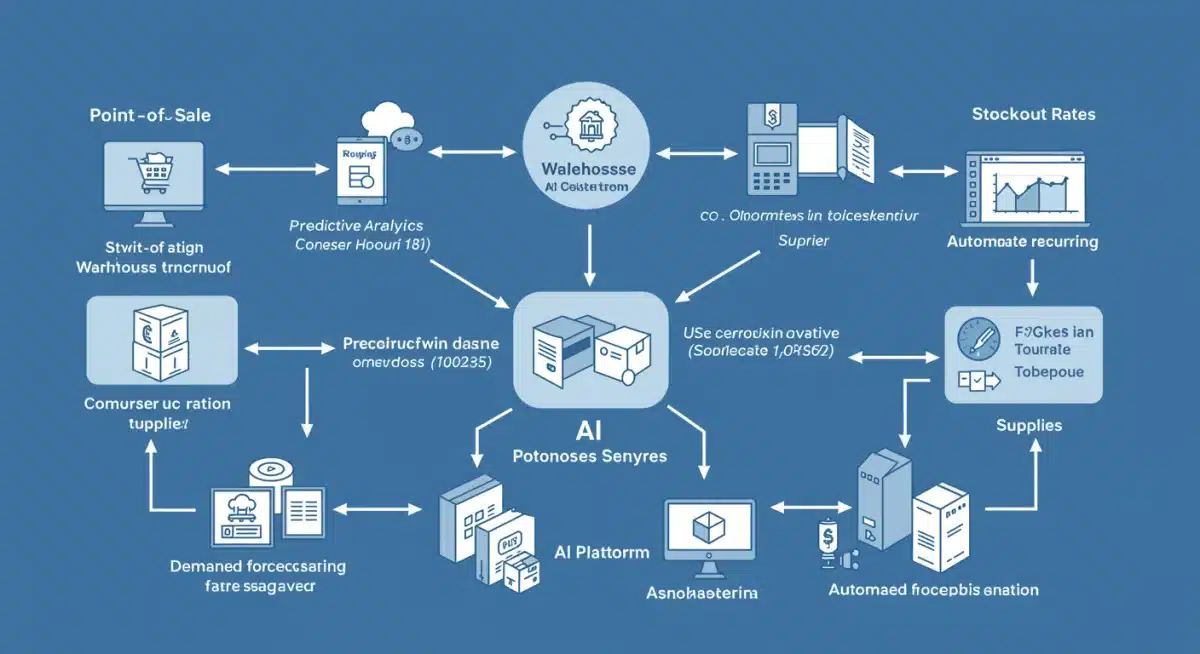
Once demand is accurately predicted, AI can automate the reordering and allocation process. This eliminates manual errors and significantly speeds up replenishment cycles. AI-driven systems can determine optimal order quantities and distribution across multiple store locations or warehouses.
These systems work by continuously monitoring current stock levels against predicted demand, factoring in lead times, minimum order quantities, and even storage capacity. When stock falls below a predetermined threshold, or when a surge in demand is anticipated, the system can automatically generate purchase orders or transfer requests.
The benefit is a streamlined, efficient, and largely hands-off inventory replenishment process that keeps shelves stocked without human intervention. This not only reduces stockouts but also frees up staff to focus on more strategic tasks, improving overall operational efficiency.
In essence, AI solutions offer a comprehensive toolkit for retailers to move beyond reactive inventory management, embracing a proactive, data-driven approach that significantly reduces stockouts and boosts profitability.
Overcoming Implementation Challenges for US Retailers
While the benefits of AI-powered inventory management are compelling, US retailers must navigate several challenges during implementation. The transition isn’t always seamless, and careful planning is crucial for success. These challenges often involve data integration, workforce training, and selecting the right technology partner.
Addressing these hurdles proactively can make the difference between a successful AI deployment and a costly misstep. Retailers need to view AI implementation as a strategic investment, requiring both technological and organizational readiness.
Data Integration and Quality
The effectiveness of any AI system hinges on the quality and accessibility of its data. Retailers often operate with siloed data across various systems—POS, ERP, WMS, e-commerce platforms—making comprehensive data integration a significant initial hurdle.
- Data cleansing: Ensuring data accuracy and consistency across all sources.
- System interoperability: Connecting disparate systems to allow seamless data flow.
- Real-time data feeds: Establishing infrastructure for continuous data updates.
- Legacy system compatibility: Adapting AI solutions to work with older IT infrastructures.
Investing in robust data infrastructure and data governance policies is fundamental. Without clean, integrated, and real-time data, even the most sophisticated AI algorithms will struggle to deliver accurate predictions.
Talent and Training
The introduction of AI necessitates a skilled workforce capable of interacting with and interpreting AI insights. This often requires upskilling existing employees or hiring new talent with expertise in data science and AI.
Training programs should focus on familiarizing inventory managers with AI dashboards, teaching them how to interpret predictive analytics, and understanding the logic behind AI-driven recommendations. It’s not about replacing human judgment entirely, but augmenting it with powerful AI insights.
Successfully overcoming these implementation challenges requires a holistic approach, blending technological upgrades with strategic organizational development. By doing so, US retailers can fully unlock the transformative potential of AI in inventory management.
Measuring Success: KPIs for AI Inventory Optimization
To truly understand the impact of AI in inventory management, US retailers need clear metrics to measure success. Key Performance Indicators (KPIs) provide the framework for evaluating the effectiveness of AI solutions in reducing stockouts and improving overall operational efficiency. Without a robust measurement strategy, it’s impossible to quantify the return on investment and identify areas for further optimization.
These KPIs should be regularly monitored and analyzed, allowing retailers to refine their AI strategies and ensure continuous improvement. The goal is not just to implement AI, but to achieve measurable, sustainable results.
Key Metrics for Stockout Reduction
Several critical KPIs directly reflect the success of AI in minimizing stockouts and optimizing inventory levels.
- Stockout rate: The percentage of customer demand that cannot be met due to a lack of available stock. AI aims to significantly lower this.
- On-shelf availability: Measures the percentage of products that are available on the retail shelf when a customer expects to find them.
- Inventory turnover: How many times inventory is sold and replaced over a period. Higher turnover often indicates efficient inventory management without excessive stock.
- Forecast accuracy: The deviation between predicted demand and actual sales. Improved accuracy is a direct indicator of AI’s effectiveness.
- Lost sales due to stockouts: Quantifies the revenue lost when customers cannot purchase desired items.
By closely tracking these metrics, retailers can gain a clear understanding of how AI is contributing to a more efficient and profitable operation. Consistent improvement across these KPIs validates the investment in AI technology.
Measuring success with AI-powered inventory management is an ongoing process that requires diligent tracking and analysis of relevant KPIs. This data-driven feedback loop ensures that the AI systems are continuously optimized, delivering maximum value to the retailer.
The Future of Retail: AI-Driven Inventory in 2025 and Beyond
Looking ahead to 2025 and beyond, AI-driven inventory management is not just a trend but a fundamental shift in how retail operations will be conducted. The projected 15% reduction in stockouts is merely the beginning, as AI’s capabilities continue to evolve, offering even more sophisticated solutions for US retailers. This evolution will further integrate AI into every facet of the supply chain, creating truly autonomous and intelligent systems.
The future promises a retail landscape where inventory is perfectly aligned with demand, minimizing waste, maximizing sales, and delighting customers with consistent product availability. This vision is powered by continued innovation in AI and its application to complex retail challenges.
Hyper-Personalized Inventory and Micro-Fulfillment
As AI becomes more advanced, it will enable hyper-personalized inventory strategies. This means predicting demand not just at a store level, but for individual customer segments or even specific local demographics. This level of granularity will allow for highly optimized stock placement.
Micro-fulfillment centers, strategically located closer to urban populations, will leverage AI to manage their highly compressed inventories, ensuring rapid delivery and minimizing the need for large, distant warehouses. AI will orchestrate the movement of goods within these compact spaces, from inbound receiving to outbound shipping, with unparalleled efficiency.
The integration of AI with robotics and automation within these micro-fulfillment centers will further accelerate the process, making same-day or even hourly delivery a standard expectation for consumers.
Ethical AI and Sustainability in Supply Chains
Beyond efficiency, AI will play a crucial role in fostering more ethical and sustainable supply chains. By optimizing inventory, AI directly reduces waste from overstocking and minimizes the carbon footprint associated with excessive transportation and warehousing.
AI can also monitor supplier performance for ethical labor practices and environmental compliance, integrating these factors into procurement decisions. This ensures that retailers not only operate profitably but also responsibly, aligning with growing consumer demands for sustainable products and practices.
The future of retail inventory management, driven by AI, promises not only financial gains through stockout reduction but also a more responsive, sustainable, and customer-centric industry. US retailers who embrace this transformation will be well-positioned for long-term success.
| Key Point | Brief Description |
|---|---|
| Predictive Analytics | AI algorithms forecast demand with high accuracy by analyzing diverse data, reducing stockouts. |
| Automated Reordering | AI systems automatically generate purchase orders and manage stock transfers, preventing shortages. |
| Data Integration | Seamless connection of POS, ERP, and other systems crucial for AI effectiveness. |
| KPI Monitoring | Tracking metrics like stockout rate and forecast accuracy to measure AI impact and optimize. |
Frequently Asked Questions
AI utilizes machine learning to analyze vast datasets, including external factors like weather and social media, providing dynamic and highly accurate demand forecasts. Traditional methods often rely on static historical data, making them less responsive to real-time market fluctuations and unforeseen events.
Key challenges include ensuring data quality and seamless integration across disparate systems (POS, ERP), upskilling the existing workforce, and selecting the right AI vendor. Overcoming these requires strategic planning and investment in both technology and human capital for successful adoption.
Yes, AI is equally effective at preventing overstocking. By providing precise demand forecasts and optimizing order quantities, AI helps retailers maintain optimal inventory levels. This minimizes carrying costs, reduces waste, and frees up capital that would otherwise be tied up in excess stock, improving profitability.
AI leverages a wide array of data, including historical sales, promotional data, seasonal trends, customer demographics, competitor activities, weather forecasts, social media sentiment, and macroeconomic indicators. This comprehensive data synthesis enables highly nuanced and accurate demand predictions for various products.
The timeline for seeing results can vary, but many retailers experience significant improvements within 6 to 12 months of a well-executed implementation. Initial benefits often include improved forecast accuracy and a noticeable reduction in stockouts for high-volume items, with broader impacts unfolding over time.
Conclusion
The journey towards a 15% reduction in stockouts for US retailers by 2025, powered by AI, is not just an ambitious goal but a strategic imperative. By moving beyond outdated methods and embracing the predictive capabilities of artificial intelligence, businesses can transform their inventory management from a persistent challenge into a significant competitive advantage. From dynamic demand sensing to automated reordering, the practical solutions offered by AI are poised to redefine operational efficiency, enhance customer satisfaction, and drive sustained growth in the evolving retail landscape.