
Optimizing US Customer Experience: Discovery to Delivery 2025
This article provides practical solutions and a detailed analysis for optimizing the US customer experience from initial discovery to final delivery in early 2025, addressing critical touchpoints and emerging consumer behaviors.

Bridging Generational Gaps in US Online Shopping by 2025
Bridging generational online shopping gaps by 2025 requires understanding diverse consumer behaviors and implementing inclusive digital strategies to ensure equitable access and engagement across all age groups in the US.

Brand Loyalty in Flux: 40% of US Consumers Switching in 2025
By 2025, 40% of US consumers are expected to switch brands, driven by evolving expectations for value, personalization, and ethical practices, posing significant challenges and opportunities for businesses.

Conscious Consumption: 5 US Consumer Segments Driving Sustainable Purchases in 2025
The landscape of US consumerism is rapidly evolving, with conscious consumption becoming a dominant force. This article explores the 5 distinct consumer segments leading the charge in sustainable purchases by 2025.
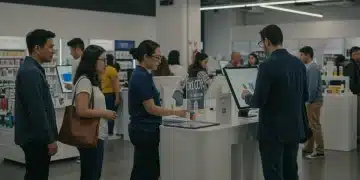
Crafting Compelling Narratives: US Brands Resonate in 2025
To resonate with US consumers in 2025, brands must master authentic storytelling, leveraging emotional intelligence and data-driven insights to build lasting connections and drive engagement effectively.
2025 US Shoppers: Speed, Convenience, or Price?
For 2025 US shoppers, the critical drivers are shifting, with a nuanced interplay between speed, convenience, and price, demanding businesses adapt to a more sophisticated consumer expectation landscape.

Peer Influence: Driving US Consumer Decisions in 2025
In 2025, peer influence and social proof are profoundly shaping US consumer decisions, moving beyond traditional marketing. This article analyzes recent updates and comparisons, offering vital insights for marketers navigating the evolving digital landscape.

BNPL in 2025: US Consumer Impact & Financial Analysis
The 'Buy Now, Pay Later' (BNPL) phenomenon is reshaping US consumer spending habits in 2025, offering flexible payment options but necessitating a careful understanding of its financial implications and potential debt risks.

Consumer Trust in 2025: Why 60% of US Shoppers Demand Transparency
By 2025, 60% of US shoppers will unequivocally demand transparency from brands, driven by evolving digital landscapes and a heightened awareness of corporate practices, fundamentally altering the dynamics of consumer trust and brand loyalty.

Personalization Pays: US Consumer Demand to Rise 15% by 2025
By 2025, US consumers anticipate significantly more personalized experiences, leading to a projected 15% surge in demand. This shift underscores a critical financial imperative for businesses to adapt and innovate.